Every version you run, and how long it still gets fixes
Every version your client sites run, every version they ship, and how long each one still gets security fixes.
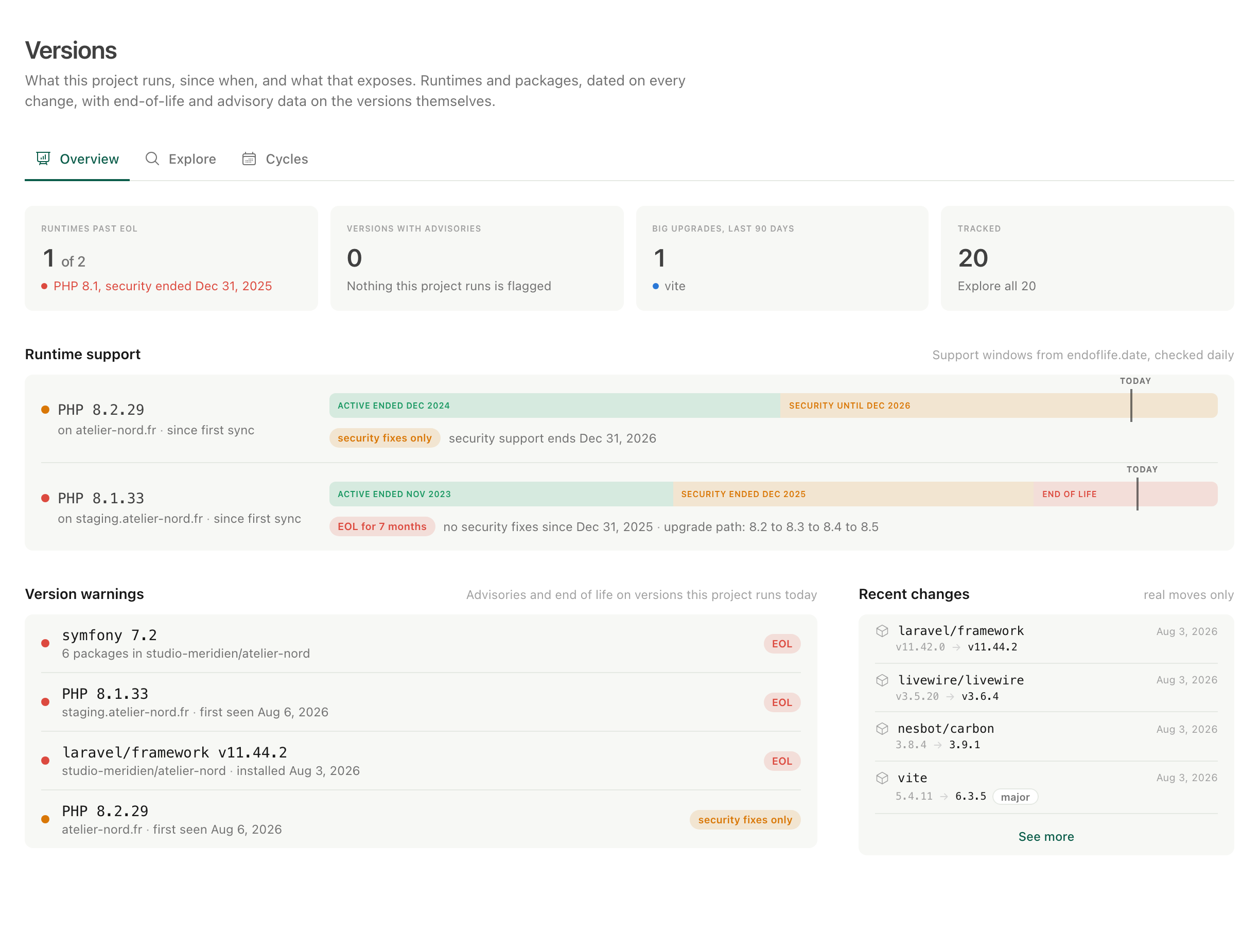
Ask an agency which of its client sites still run a supported PHP and you will get a pause, then a guess, then somebody opening servers one at a time. The information exists. It is just spread across eleven hosting accounts and nobody's job.
Unolia's Versions area answers it in one place.
It tracks what a project runs, captured from the sites themselves, and what a project ships, read from its own releases and tags. The dependency history comes out of your lockfiles, walked commit by commit through the repository rather than sampled at the tip, on GitHub and GitLab alike. That happens the moment a git account connects, so a project has its timeline before anybody thinks to push.
Unolia then syncs the published support windows for PHP, Laravel, Symfony and the rest from endoflife.date every day, and each version reads as one of three things: active support, security fixes only, or past end of life. A dead version comes with the date it died and the versions still alive to move to. A cycle has its own page in the vendor's own words, and a package's history hatches out the series that are already gone, so it reads itself.
A runtime past end of life then opens a real issue on the project, so it reaches the morning list and the security view alongside the CVEs, instead of sitting as a badge on a page you never open. It opens whether or not anybody deployed, because the daily cycle sync notices a date passing on its own, and it closes itself when the version moves.
I used to keep a browser tab open on endoflife.date. Now the project knows.